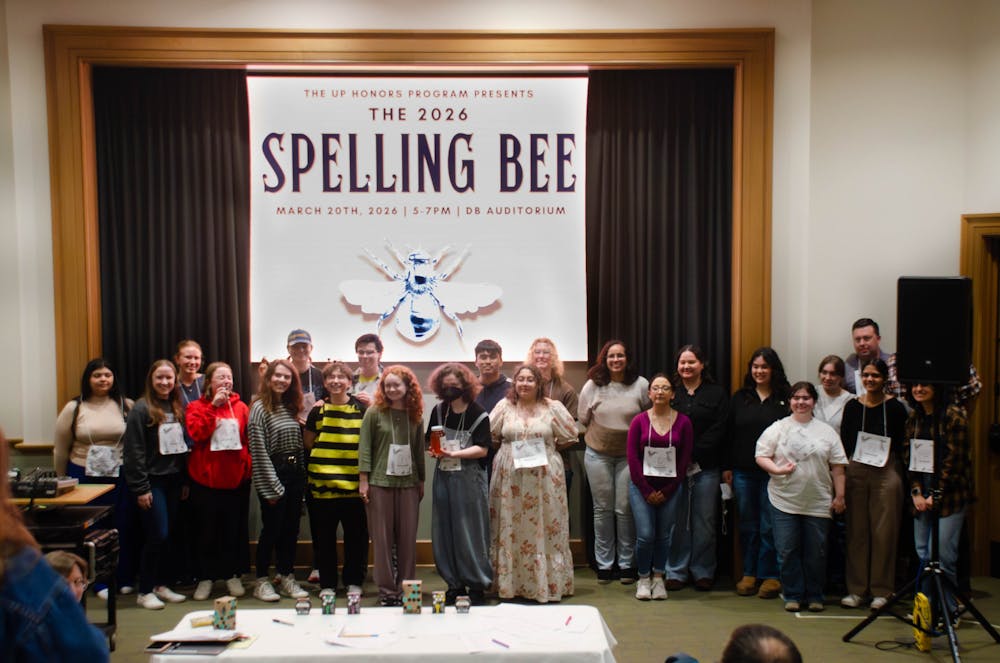
It's a Friday evening, nerves are buzzing and a student in a bee costume is holding a microphone, which could only mean one thing: UP Honors Program’s first Spelling Bee.
On March 20, 25 brave spellers competed for a grand prize that included 24 chapsticks, three bars of soap and two simple salve balms from Portland Bee Balm, a quart of local Portland honey from Bridgetown Bees and $100 in cash.
Megan Lester, undergraduate scholarly engagement program manager, leaned into the theme when planning the event, which in this case meant the winner would “never be chapped again.”
She said the event was inspired by the Scripps National Spelling Bee and featured words from its 2004 Consolidated Word List.
But the bee’s debut on The Bluff was the brainchild of honors program sophomore Samuel Koehler, who said the purpose of the event was student engagement.
“I really want people to care about academic competition,” Koehler said. “I get a little sad when I'm in classes where people don't want to raise their hand, or they think it's okay to rely on AI to do their work. I think it's so important that we keep competitions that rely on your performance and knowledge alive.”
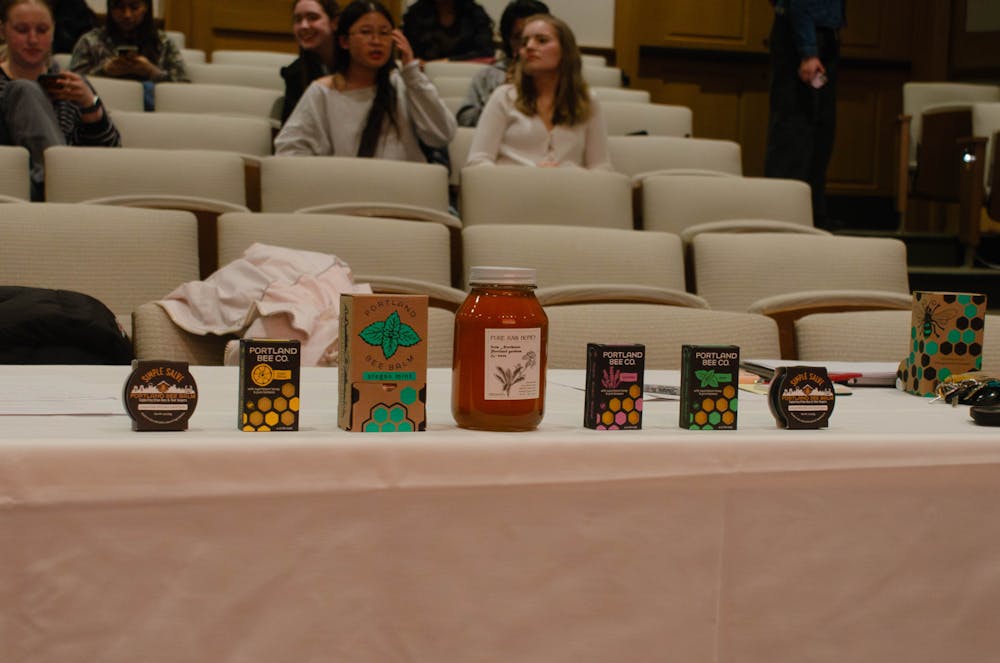
An array of bee-themed prizes at the Spelling Bee.
Koehler pitched the idea to the Honors Student Advisory Board earlier this year after watching a high school production of the Tony Award-winning musical, The 25th Annual Putnam County Spelling Bee. Ever since, he has been envious, not of the spellers, but of the adjudicator of the competition.
In front of four rows of spellers and an auditorium full of enthusiastic supporters, Koehler finally had his moment in the judge and host chair.
Sophomore Shagun Joshi and junior Olivia Herning anxiously awaited their time at the mic, though each prepared for the competition differently. Joshi snuck in 15 minutes of spelling practice, whereas Herning hoped her vast history of reading would come in clutch.
At the event’s tip-off, Koehler outlined the procedure of the bee, which included several rounds of spelling that would increase in difficulty until two competitors were left standing for the final spell-off.
Spellers nervously approached the mic with loud cheers and claps from a nearly full Dundon-Berchtold (DB) Auditorium. Round one commenced with words like “scheme,” “extinct,” “wrestle” and “dolphin.”
Competitors had two minutes to spell each word. Some asked for the definition, the origin and a sentence using the word, but rounds one and two defeated very few participants.
Spellers faced words like “ominous,” “legislature” and “neutralize” in round three. As the competition got tricky, participants traced the word on their palm — a visualization technique that Koehler recommended.
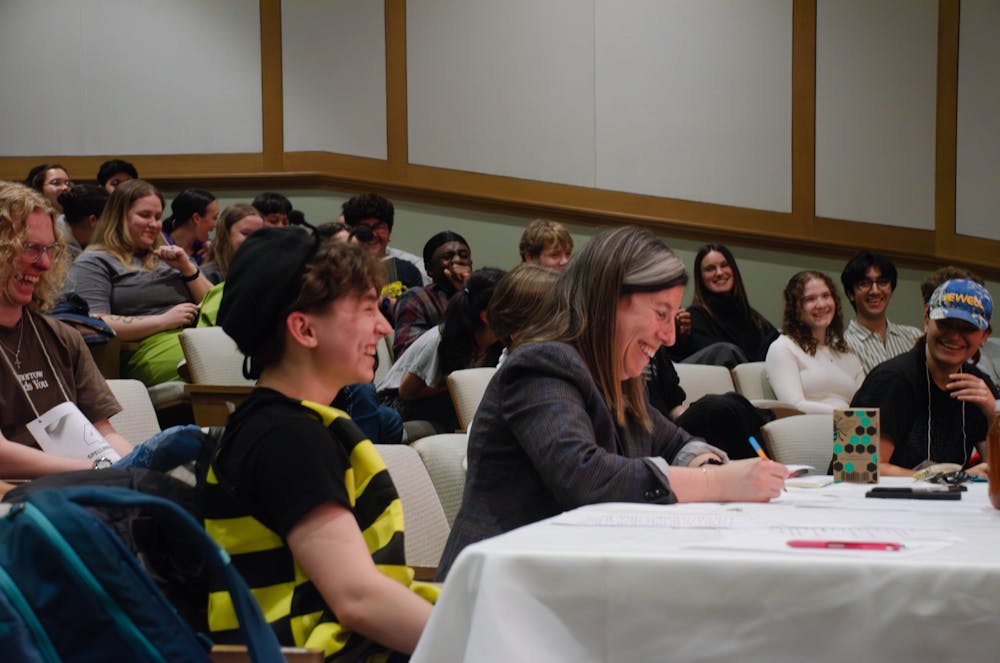
Dr. Cara Hersh engages with contestants.
The air seemed to grow thick with anticipation as the rounds increased, and round four was no exception. If their spelling was incorrect, competitors were given a “participatory chapstick” from Portland Bee Balm before joining the audience.
Even Koehler struggled to pronounce the word “kakistoceracy” for contestant No. 19 to spell, a noun meaning government by the worst individuals.
Yet after asking for the definition, origin and to hear it in a sentence, the speller, senior Branna Sundy, gave it a go.
“Kakistoceracy,” Sundy said. “K-A-K-I-S-T-O-C-R-A-C-Y. Kakistoceracy.”
It was correct. The audience erupted — a stand-out moment of the event.
When asked about the moment, Sundy said she just crossed her fingers that she would get it right.
“Honestly, I have never heard that word before,” Sundy said. “Truly, the fourth round was a situation of luck. There were some other words that I absolutely would’ve gotten out on.”
Round four eliminated a majority of the spellers, leaving only four of 25 competitors to advance.
Attempts to spell “magnanimous,” “perspicacious” and “obfuscate” brought the competition down to the finalists, first-year Maggie Kelly and Sundy.
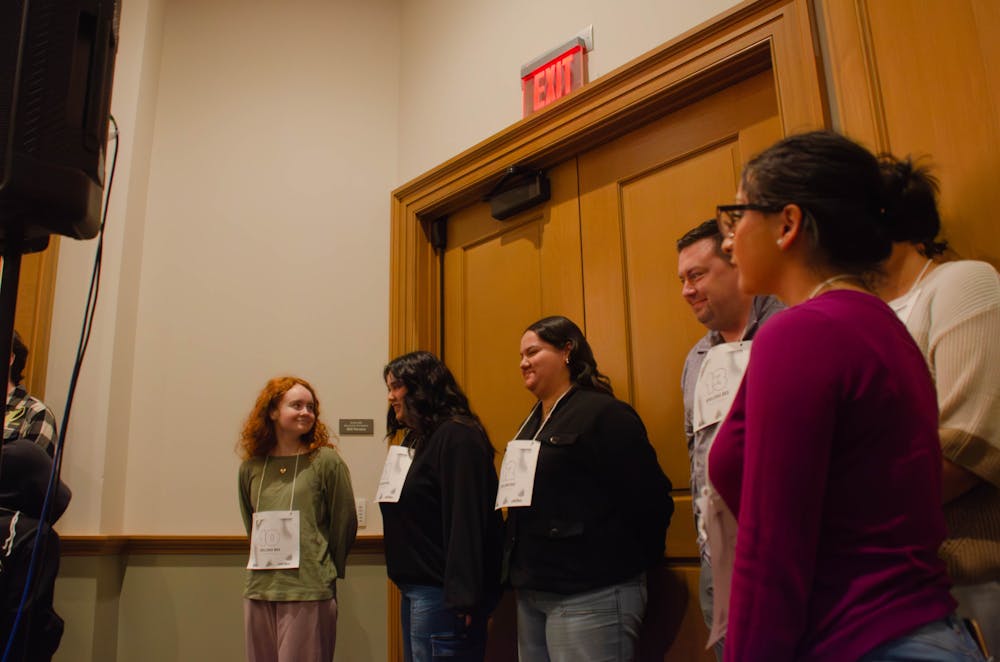
Spelling Bee contestants line up to participate in event.
The sudden death spell-off challenged the pair with the words “ubiquitous” and “intransigent,” though neither speller was stumped.
Queen bee Branna Sundy was crowned after her opponent spelled “deleterious” incorrectly, and she succeeded in spelling “idiosyncrasy.”
She participated in spelling bees in middle school, so Sundy thought she would throw her hat in the ring, but she didn’t expect to walk away with the grand prize.
“It was pretty exciting,” Sundy said. “I went in with low expectations, just that it would be a fun way to get to know people, and I was pleasantly surprised. It was a nice way to spend a Friday afternoon.”
The Honors Program’s first Spelling Bee “came to life” more than Koehler could have imagined. Looking ahead to the annual event's future, he hopes for more competitive prize incentives and student engagement that fills the entirety of DB Auditorium.
Kalena O’Connell is the News and Managing Editor for The Beacon. She can be reached at oconnell27@up.edu.