Last year, the university implemented a variety of changes for the 2025-26 school year to incentivize students to live on campus longer, including reduced housing rates and more single-room options for upperclassmen.
The incentivization worked.
With 75 more juniors staying on campus for their third year, the rate of juniors living on campus has increased from 27% to 40% in the last year. A smaller increase shows 18% to 20% more seniors are living on campus this year as well, according to Director of Residence Life Andrew Weingarten.
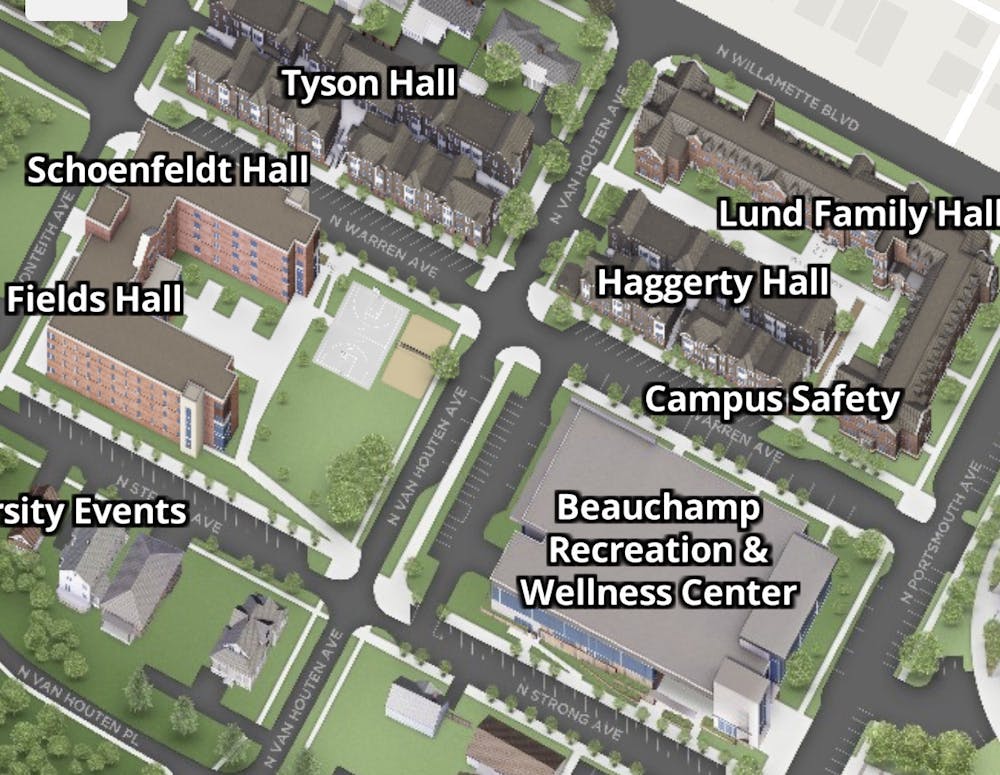
North Quad has quickly become the hub for returning students.
Lund Family Hall and Fields and Schoendfeldt Hall are now almost exclusive to returning students. Haggerty and Tyson Halls, the apartment-style dorms, continue to be reserved for juniors and seniors.
Weingarten says there are only eight first-years in Fields and Schoendfeldt Halls and 24 in Lund Family Hall. Additionally, the occupancy rate of Haggerty and Tyson Halls has increased from last year’s 65% to 90%.
Weingarten is satisfied with this increase, saying that the residence halls have specifically adapted to meet the needs of rising upperclassmen.
“The work we're really trying to do is to help our sophomores understand how there are so many benefits to staying on campus,” Weingarten said. “It wasn't surprising to me that we really moved the needle with juniors more so than seniors in year one.”
Fields and Schoendfeldt Hall have transformed the most, going from two separate dorms to a combined co-ed building. The merging of the two dorms resulted in a reduced number of hall staff and an increase in single rooms offered, according to Fields and Schoendfeldt Hall Director Jordan Duran.
Duran also says the third floor of the building has been adapted into the honors floor, exclusively housing honors program students who gain access to the floor’s lounges.
Jenna Morgan, hall director for Lund, says that while the number of first-year students in the hall has decreased, the total occupancy remains consistent.
“Aside from one Accessible Education Services room, none of the rooms [in Lund] have been designated as singles because of the popularity of the hall,” Morgan said. “We've been able to mostly fill it with students who have at least one roommate.”
Residence Assistants (RA) in each of the dorms have also adapted to better support the needs of returning students. Since upperclassmen have well-established friendships, programming in the dorms has shifted to help maintain those relationships.
“I think part of people's thought is ‘Oh, upperclassmen need less support,’” Duran said. “And that's not true, they just need a different type of support, but still close to the same amount of support.”
Pat Foronda, a third-year biology major, lived in Fields during her freshman and sophomore years and moved into Lund this year. She plans on moving to an apartment in Haggerty or Tyson next year.
She stated convenience as her main factor in remaining on campus, as she appreciates not having to worry about monthly bills, preferring to pay everything up front. Foronda also credited the amenities provided in the dorms, such as the full kitchen and free laundry, as reasons for staying on campus.
Throughout her experience living on campus, Foronda has witnessed dorm communities change. In general, she noted that the dorms are quieter now that there are more upperclassmen living in them.
“I saw more socialization [in previous years], like freshmen would go to each other's dorms to hang out, so it was a little louder,” Foronda said. “Which I don't mind, I like socialization. But upperclassmen are kind of in their own cliques already, so we won't really hang out as much.”
Similarly, Rafael Baluyut III, a third-year civil engineering major, appreciates the amenities provided in the dorms. After living in Lund for three years, Baluyut has learned to appreciate how the amenities can foster community.
“I’ve gotten more into cooking, so it helps that [Lund has] a really nice kitchen,” Baluyut said. “It’s big, so we don’t have to fight over it. My favorite thing is hosting others, like cooking with my friends and having dinner together.”
Part of Baluyut’s decision to stay on campus was his involvement in the ROTC program, which pays for his housing and meal plan. Baluyut also noted that he didn’t want to deal with the competitive housing market.
Haggerty and Tyson Halls are apartment-style dorms designed for students to experience living outside of a traditional dorm, while remaining on campus. Between the two halls, there are only three RAs who help make the space feel distinct from traditional dorms.
For Olivia Outley, a Haggerty and Tyson RA who has also lived in Fields, the reduced presence of RAs aids upperclassmen in feeling independent, while still having a support system to fall back on.
“An RA on a floor [in other dorms] is very present,” Outley said. “You see them when you’re walking around. In Haggerty, they're not knocking on your door. You're not seeing them as you're going to the bathroom. It's just a completely different situation. You definitely feel more like an adult.”
To learn more about on-campus living options and reserve housing for next year, click here.
Samantha Zavala is the Diversity, Equity and Inclusion Editor for The Beacon. She can be reached at zavala27@up.edu.