On Feb. 28, the United States and Israel began strikes against Iran, killing the nation’s leader, Ayatollah Ali Khamenei. The United Nations Secretary-General António Guterres said that the strikes “undermine international peace and security.”
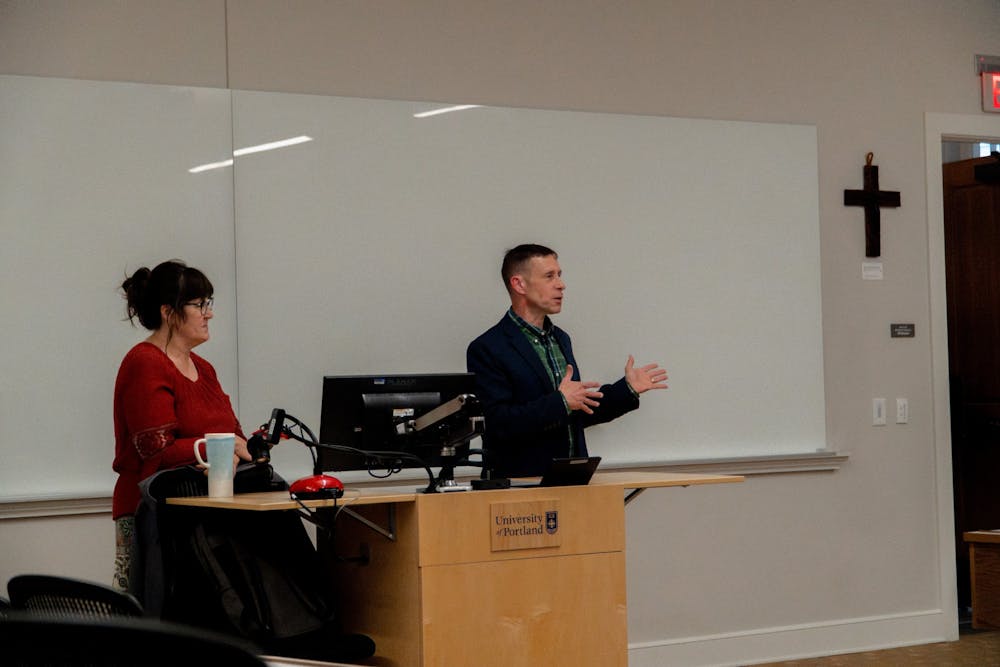
On March 17, an event titled “Q&A: Why ‘Operation Epic Fury’” attempted to contextualize the conflict through a Q&A-style talk. The discussion was hosted by Dundon-Berchtold Faculty Fellow for Constructive Dialogue and political science professor Anne Santiago in Dundon-Berchtold Hall.
The panel included Santiago, political science professor Jeffery Meiser and former Army Colonel and political science instructor John Zavage.
The Beacon attended the event to recap attendees’ questions and gather insights from the panelists.
Question:
“What strategy is the U.S. using during this conflict?”
Anne Santiago:
“We are viewing the region from an external, Western perspective. … The Trump administration is acting in the short term, looking at this as if we could fix the threat through military use. I would venture to guess that Iran is looking at this as ‘We will withstand this because that is the power imbalance that we have between a power that is as militarily strong as the United States and a country like [us] that has some military power in the region.’ But its weapon is really one of asymmetrical warfare. I would say that is the difference between the United States [having] an attitude [that] everything will function according to this Western perspective within the globe.”
Jeffery Meiser:
“[The U.S.] is taking military actions because [they] want to cause political effects. This is what politics are always about. The U.S. has had decades and decades of trouble with this because we have lots of military action. We can take a lot of military resources and do a lot of military stuff, but it ends up [being] really hard to make it because of these political effects. That’s like the gold standard of what you want from strategy. You take action and cause something to happen. [Right now] all that the [U.S.] wants to do is ‘mow the grass.’ It’s a terrible euphemism because ‘mowing the grass’ is killing people and destroying stuff. What do you have to do when you mow the grass? You mow it again, whenever you need to, you just do it again.”
John Zavage:
“It’s true we’ve engaged in this really complex military operation with the hope of creating some political effect, and we don’t know the complex algorithm. Nobody can know. Now, with all of that said, if you were to think about it in different terms, the parallel viewpoint is that what we’re seeing now is the culmination of the Trump administration's eight-year-long effort to — for lack of better words — measurably neuter the Iranian ability to ever gain a nuclear weapon. And at the same time, neuter their ability to threaten the region with their ballistic missile program. … This is just the culminating decision of eight years of policy analysis. That said, if we want to both eliminate the nuclear program and have regime change, those are two ridiculously immense objectives. One doesn’t necessarily lead to the other. There can be a better argument than what we’ve heard so far in public messaging.”
Question:
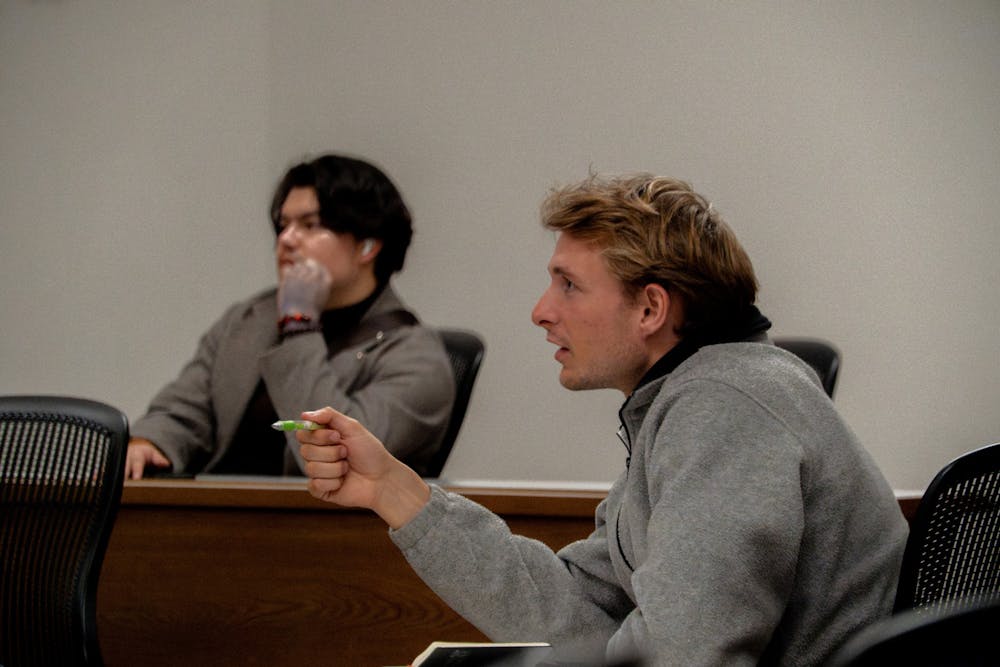
“With the buildup [of tension], was the conflict we are currently in expected to happen eventually because of [Iran’s] dislike towards American values?”
John Zavage:
“Some observers may have expected it, but I would not claim that this conflict, to this extent, was widely expected, at least not until just a few days before it started. That said, this Iranian regime has made anti-Americanism a pillar of its foreign policy – indeed, of its entire public-facing legitimacy – since its inception in 1979. In 1979, due to a confluence of factors, including poor economic conditions and strong public dissatisfaction with Western and American influence, a religious movement led by Ayatollah Ruhollah Khomeini engineered a radical revolution based on a conservative Shi’ite Muslim ideology. As time went on, the Iranian regime viewed opportunities to attack American interests in the Middle East as integral elements of its foreign policy, which led to several attacks on Americans and American interests. … Regardless, until right before ‘Operation Epic Fury’ began, I don’t think it would have been accurate to say that a conflict of this magnitude was expected, at least not by many.”
Question:
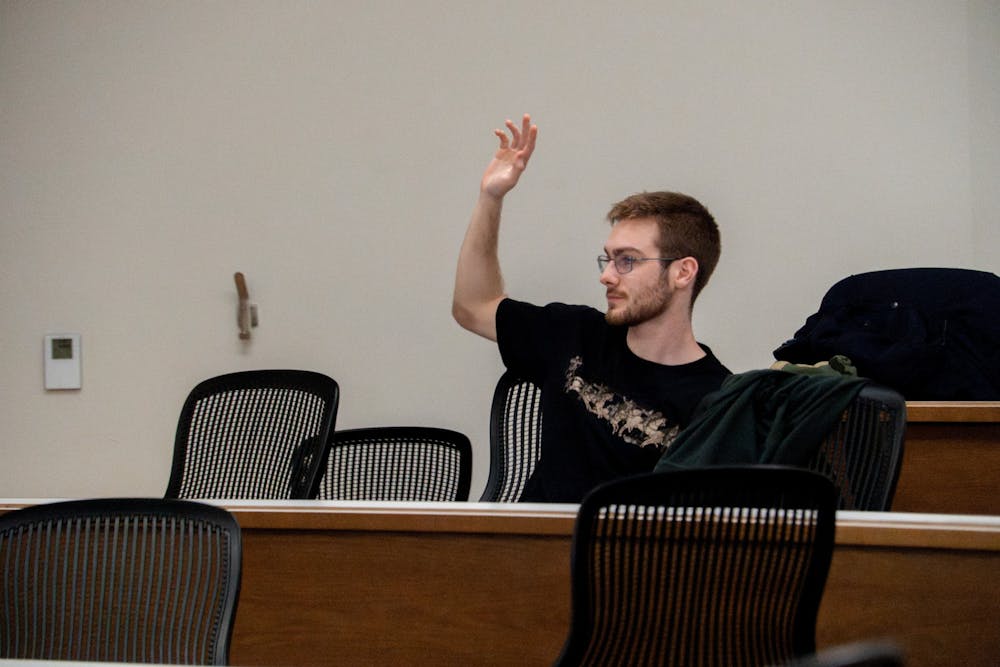
“Since this conflict kind of began with the purpose to destroy [Iran’s] nuclear weapons, would it be correct to say that that is accomplished?”
John Zavage:
“Not quite, or not yet at least. The attacks have certainly damaged Iran’s nuclear weapons program, but it is nearly impossible — without physically inspecting every known and suspected nuclear weapons facility — to know whether Iran’s nuclear weapons capability has been destroyed or not.”
Question:
“Why are people in support of this conflict?”
John Zavage:
“When I hear U.S. military members talk about what they’ve done and when I hear Israeli mouthpieces talk about what they’ve done, I hear them targeting the Iranian Revolutionary Guards Corps. So it’s really talking about a broad and deep sort of embedded network of militant-minded Iranians for whom their sole recognition of Iran’s mission is precisely to export and expand the Iranian ideology to the region outside the borders of Iran. They’ve proven that they have and will do it with violence. I hear the U.S. and Israelis describe their intent to fight the Iranian Revolutionary Guards Corps and the military, and not the Iranian people. I know that’s what they intend for that message to be, but I fully empathize that this message is not necessarily coming through in this manner to a broader audience. Separately, the Responsibility to Protect doctrine has been invoked for less than what the Iranian regime did two months ago when they killed thousands of their own protesters. If the United States wanted to make this a more benevolent-sounding mission, could we not have taken greater care to build a Responsibility to Protect case and then claimed to have acted as the United Nations standard bearer for this doctrine?”
Darcy Boss is a news reporter for the Beacon. She can be reached at boss29@up.edu.