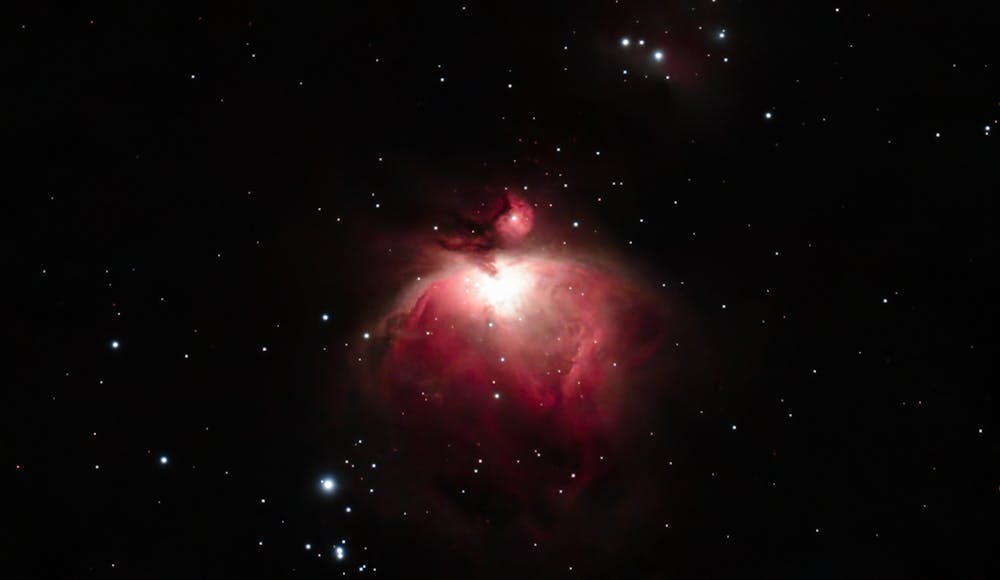
1,500 light years away sits the Orion Nebula, the closest star-forming region to Earth. In order to get this photo, I drove 45 minutes to L.L. Stub Stewart State Park and set up my smart telescope to track and shoot continuous photos of the nebula for over an hour.
The process of driving to a dark location, setting up my camera and enduring the cold night created an image-capturing experience that doesn’t compare to anything I’ve ever done.
Rather than capturing moments as they happen like regular photography, astrophotography focuses on capturing light that has traveled for thousands or even millions of years before making it to Earth.
That's part of what makes astrophotography the most rewarding kind of photography you can do.
Unfortunately, astrophotography has also been maybe the least accessible type of photography. Traditional setups have required large telescopes, expensive star tracking hardware and pricey cameras.
I'd have to sell a couple of organs in order to afford them.
Fortunately, advances in technology have actually made it much easier to get started. Today you can buy a smart telescope that fits snugly in a backpack for as low as $400, compared to traditional setups that are priced comfortably over $1,000.
My own smart telescope has allowed me to take photos I never considered being even remotely possible to capture.
But price isn’t the only thing getting in the way of capturing stunning photos of the cosmos. Bad weather is impossible to avoid, especially in the Pacific Northwest, where it’s not uncommon for clear skies to come by once every few weeks.
Then, after a clear sky finally comes around, the process still takes time. You spend hours taking a single photo just to spend a couple more with post processing.
Once you’re finally done, the photo feels earned. It’s a journey unique to astrophotography, and in the end, the final photo feels like a full experience.
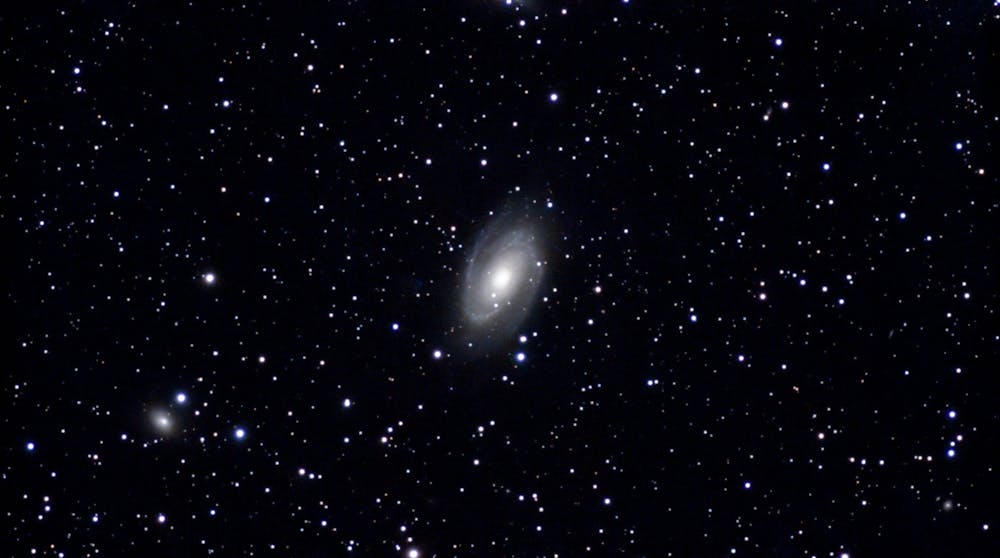
This photo, which I captured from the Academic Quad, prominently features Bode’s Galaxy, which is 11.1 million light years away from Earth and is estimated to house 250 billion stars.
It’s not the only galaxy in this photo though.
The little fuzzy oval in the bottom left third of the frame is also a galaxy. As are the two very tiny fuzzy dots in the bottom right corner. There are likely many many more galaxies hiding in this photo that could be revealed by taking longer exposures in this piece of the sky.
Space is so incomprehensibly vast that it’s hard to even process what you’re seeing when you look at a photo like this. Imagine how big these galaxies must be in order for us to see them from Earth, 11.1 million light years away.
That’s what makes astrophotography feel so different. On top of the journey to capture each one, the photos give a tiny glimpse into that vastness, and it’s hard not to wonder what else might be out there.
Evan Guerra is the multimedia editor for The Beacon. He can be reached at guerra28@up.edu
Have something to say about this? We’re dedicated to publishing a wide variety of viewpoints, and we’d like to hear from you. Voice your opinion in The Beacon.