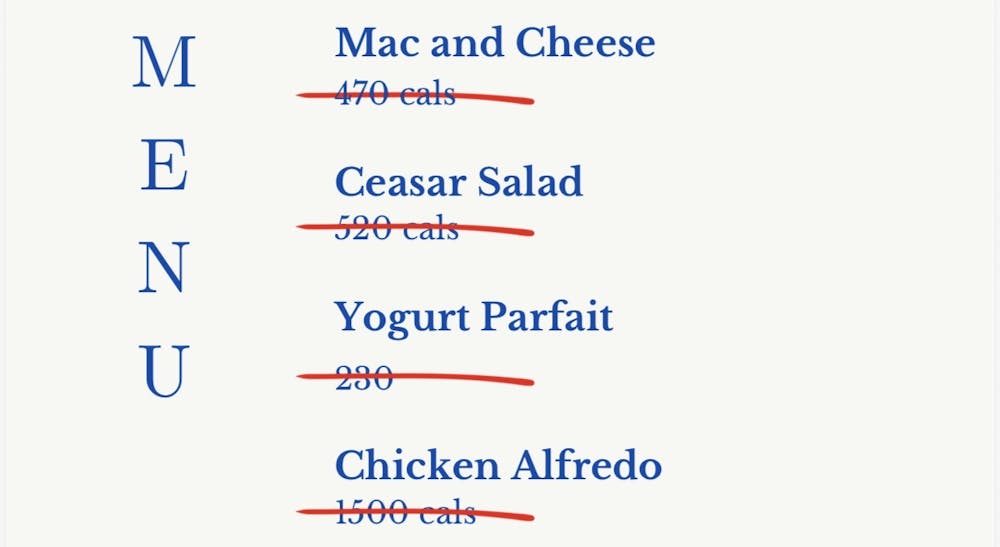
Have you ever been so excited to get your favorite food at a restaurant, but then you see the not-so-small numbers right below the description?
I always think to myself, is it really necessary to put the total amount of calories on menus? I don’t think so – menus should promote a positive relationship to food.
Research shows that people dining in a restaurant tend to avoid foods with high calorie counts.
Further, PubMed recognizes that while providing calorie counts on menus may be beneficial to reduce obesity rates, it greatly harms those with disordered eating habits.
In 2018, all chain restaurants in the United States were mandated to provide the calorie counts on their menus. Such a requirement lacks consideration for those with present or past eating disorders.
This was a requirement set to target the United States’ high obesity rates, but legislation didn’t consider the possible misuse of such a mandate.
Mandators need to consider and, most importantly, understand how people are going to interact with the calorie information on the menus, both positively and negatively.
By recognizing both sides of this complex issue, the British Psychological Society conducted a survey that resulted in discovering a recommendation that considers all sides and purposes.
Menus that include calorie counts should be available upon request, but menus without calories should be the primary ones provided out of consideration for those with past or present eating disorders, or those working towards recovery.
Without the calories on menus, those who struggle with disordered eating habits or who are on the path to recovery still have a difficult time getting themselves to eat out.
When we add the high possibility of seeing the calorie counts on menus, this becomes even more challenging.
If someone is on the path to recovery and they see the calories on the menu, it can increase the risk of relapse and trigger many thoughts that have been hard worked on to prevent and rephrase.
If mandators could understand this impact, even if it doesn’t seem like a big problem to them, we could better support those with disordered eating habits in their process of creating a healthy relationship with food.
Darcy Boss is a news reporter for the Beacon. She can be reached at boss29@up.edu.
Have something to say about this? We’re dedicated to publishing a wide variety of viewpoints, and we’d like to hear from you. Voice your opinion in The Beacon.