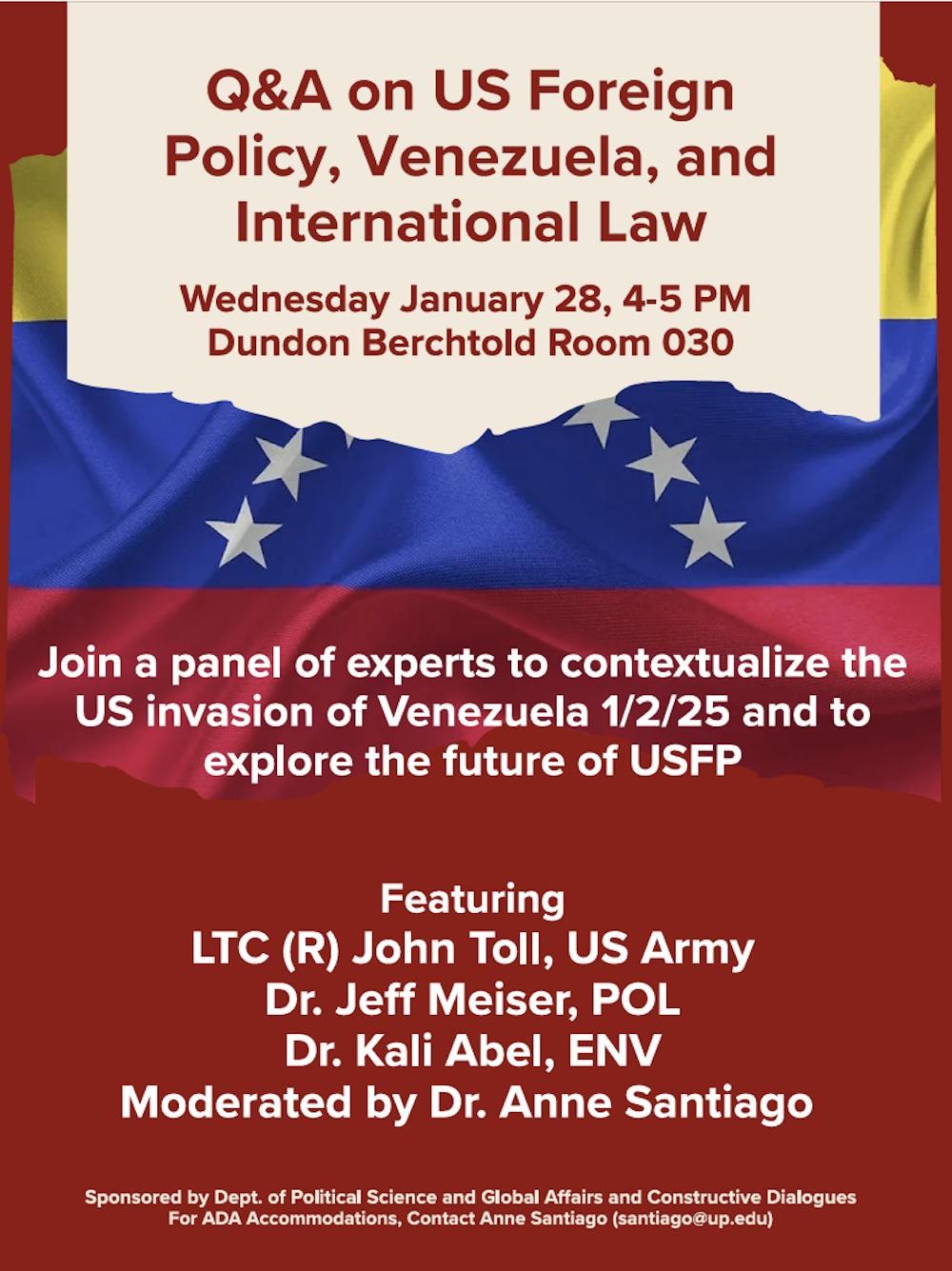
At a panel event titled “Q&A on U.S. Foreign Policy, Venezuela and International Law,” the speakers agreed that the United State’s military operation in Venezuela was less about regime change and more about domestic politics and access to the country’s oil deposits.
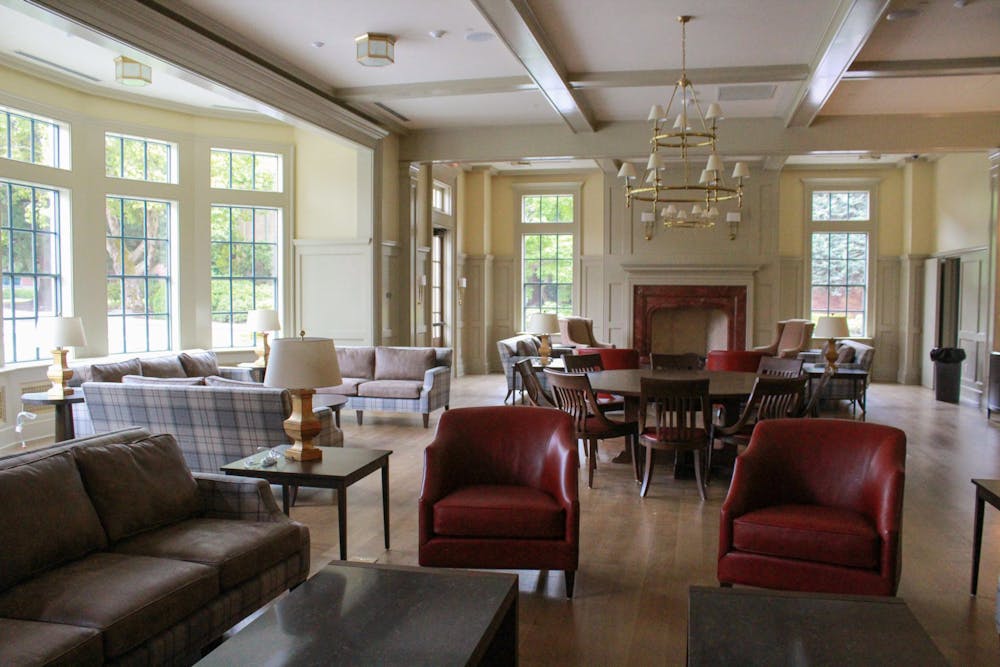
The Jan. 28 event was hosted by Dundon-Berchtold Faculty Fellow for Constructive Dialogue and Political Science Professor Anne Santiago in the first-floor lounge of Dundon-Berchtold Hall.
The event aimed to address the U.S.’ military operation into Venezuela to capture President Nicolás Maduro on drug-trafficking and weapons charges. The operation, framed by the U.S. as part of its campaign to combat narcotics in the region, has drawn international speculation on its legality.
The panelists were Lieutenant Colonel John Toll, political science professor Jeffrey Meiser and environmental studies professor Kali Abel.
Before allowing for questions from the audience, Santiago began with a question of her own.
“What do you think the U.S. incursion into Venezuela to extract Nicolás Maduro is all about?” Santiago said. “What are the implications of this?”
Meiser said that his understanding of the operation was that President Donald Trump prioritized domestic support for his actions when making the call.
“I would say that it seems that Trump likes a few things,” Meiser said. “One of them is that he wants something you can call a win. As a foreign policy win, it has support. Forty-nine percent of Americans support it, far less people oppose it. So it's a foreign policy win for him.”
When discussing the factors Trump may have considered when deciding on military action in Venezuela, Toll offered a structured decision-making framework called diplomatic, information, military and economic (DIME).
The model is used to determine the action the government will take in regard to foreign policy, with each factor contributing to the final decision, according to Toll.
Abel then explained how Venezuela’s former dictator, Maduro, got to the point where foreign intervention ended up removing him from power.
“Maduro got caught in the loop that a lot of dictators get caught in, right?” Abel said. “You've got to maintain power, and in order to maintain power, you've got to repress. The more you repress, the more people who potentially want to overthrow you.”
Abel was then asked whether she thinks that the intervention in Venezuela has to do with international trade, to which she responded that it was a factor in the decision.
“[In 2017] there were U.S. sanctions on Venezuelan oil in an attempt to piss people off, to get people to rise up against Maduro and affect regime change … [and] it didn't work,” Abel said. “It actually created more anti-American sentiment rather than anti-Maduro [sentiment].”
Meiser said that for Trump, the military operation in Venezuela was an example of weighing risk to potential reward.
“[Trump] knew that the [military operation in Venezuela] was possibly a costly action, right?” Meiser said. “And he did it anyway. So for him, it was worth having that risk to get something out of this, whether it's oil, a domestic political win or something else.”
Owen Lefort is a News Reporter for The Beacon. He can be reached at lefort29@up.edu.