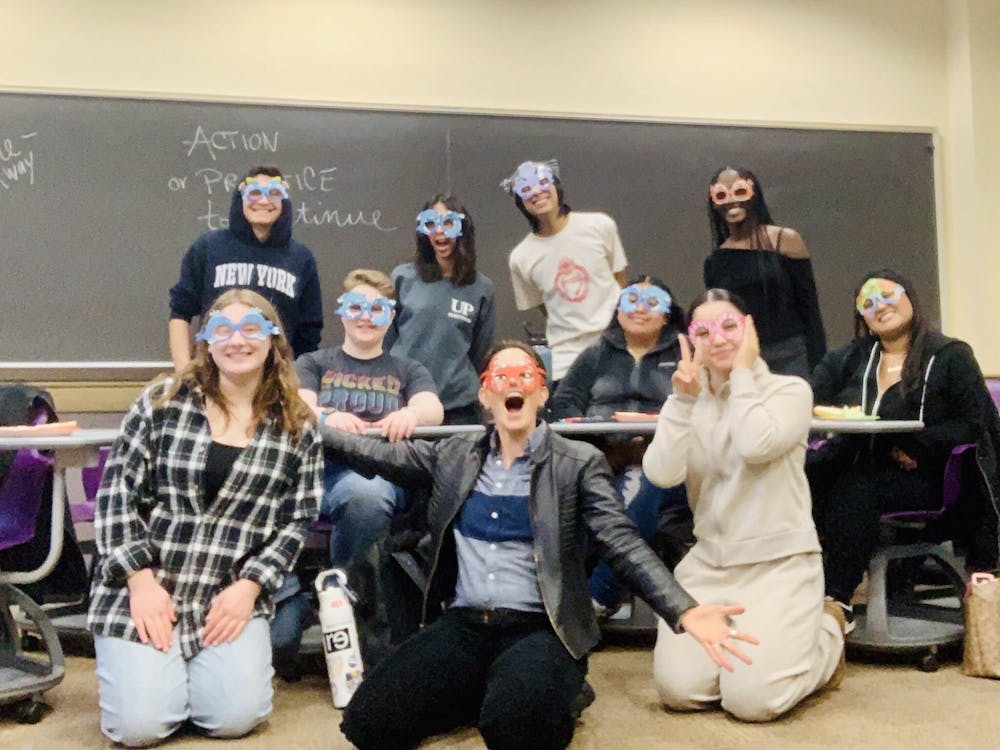
On Nov. 6, 2025, hours after U.S. Immigration and Customs Enforcement (ICE) had already been in St. Johns separating families, we finally received an alert from UP. In the email, Michael McNerney, the director of campus safety, stated, “Please note that we have no direct information that enforcement action is directed toward the University or our community.”
To students like us, this was such a harrowing and ignorant comment because we and our community are already being directly impacted by ICE action. Thus, this article is a collection of testimonies to break this harmful assumption and demand that UP have a transparent, concrete ICE protocol, require all staff, faculty and students to do Moodle “Know Your Rights” modules, hold in-person trainings with trusted community organizations and connect with community organizations advocating for migrant community members.
Ixtzel Pina
I remember being only 8 years old when my mom told me my dad wasn't going to come back home because he was stopped by ICE agents and taken to the Northwest Detention Center in Tacoma.
We were able to find a lawyer to help us with the case, and within a year, he was released, which is something that not every family is so fortunate to experience.
Being a first-generation Mexican American and seeing everything that is happening right now to our community is heartbreaking.
Remembering that trauma when I was only a child and seeing how many communities are suffering the same experiences hurts me as well.
Seeing how many people have been arrested back at home, where I live in Gresham, but also right here near campus, makes me feel panicked for those who live in fear.
However, now it’s not just undocumented individuals being targeted, but anyone who fits the stereotype of simply being brown — landscapers, construction workers, those with a Hispanic accent, etc. There have already been cases here in Portland of U.S. citizens being detained and harassed by ICE.
As a community we are suffering and feel like there's no hope in asking for help from our elected officials.
But hard times also lead to advocacy. I’ve seen people in my community connect undocumented individuals with lawyers and deliver food for those who are scared for their safety.
There is a quote that truly resonates with me: “Hoy por ellos, manana por nosotros,” which means, “Today for them, tomorrow for us.” I say this because at some point my family needed help from our community, and it was through them that we were able to fight and not give up.
Now it is up to us to show the same support. We should find empathy and compassion for those in difficult situations; you don't have to go through family separation by ICE to feel frustrated about it.
It is through immigration that most of us have been granted the opportunities we have today. Seeing how other schools are quick to respond to ICE around their campuses makes me wish that ours took the same initiative.
Today we fight for all students and their families and tomorrow for us, because one day this could happen to a loved one, friend or neighbor.
Michelle Fugon Guerro
As an immigrant who came to the United States from Honduras at just 10 years old, I had the privilege to become a U.S. citizen by the age of 18. I understand how immigration systems shape every part of a person’s life and how important it is to feel supported when it’s most needed, which is why I believe UP needs to be more vigilant about ICE.
Growing up, I had to mature quickly in order to translate for my mom and navigate school and legal documents on my own. I felt pressure to protect myself and my family. I went through the entire college application process alone, coordinated resources for my community and learned to advocate for myself in a country that didn’t always make space for immigrants.
These experiences showed me how easily families can be mistreated or overlooked. With the recent ICE activity and detainments near campus affecting students attending UP, there is a need to speak up for and support those who are being affected.
My community is in danger, and my people are being mistreated without a chance to defend themselves and their families. Stories like mine and the many others who face similar or even more difficult challenges show why ICE activity can have such a damaging impact on immigrant communities, no matter your status.
Because of everything I’ve lived through, I know how important it is for UP to recognize these realities, stay alert and ensure immigrant students and their families are supported and protected.
Maria Zacarias Martin
When I was young, about two or three years old, my family was impacted by ICE. I saw my family members hugging my mother, heartbroken by the situation. I didn’t understand what was happening, but as time went on, I was able to see the event’s effects on my family.
Recently there has been lots of ICE activity throughout Oregon, and many families in my community are being impacted. Seeing our family friends go through these hard times is upsetting.
There have been two confirmed detainments near UP, and yet, our campus fails to inform us. Families aren’t able to go out to grocery shops or go out with their children because they live in fear of ICE in their neighborhoods.
Because of these fears, I have the responsibility and pressure of running errands to protect my family’s safety. This can be a common experience among UP students who also fear for the safety of their loved ones.
I believe that the university is not properly advocating for students going through this situation, and I would like to see UP start speaking up and offering help.
Maddie Winter
Unlike many other students, I have the privilege of not fearing for myself or my family’s safety every day. As a white American citizen, I can feel safe knowing that ICE isn’t directly coming after my family or me. But I still don’t feel safe because I know my friends, classmates and community are being greatly affected.
I remember being in a social work class where we were going around sharing how we were doing, and I shared my frustration with something going on with the Women’s National Basketball Association.
Soon after, three of my classmates shared that someone they know personally was picked up by ICE over the weekend.
My stomach dropped, and my heart felt like it stopped. I immediately felt so embarrassed by what I had shared and by the things in my life that I thought were problems, when all around us, people are literally fighting for their lives.
If you’re like me, and you don’t have to worry about your safety every day, please remember that it’s a privilege. And please do whatever you can to use that privilege to help make our friends, classmates and community members feel safer.
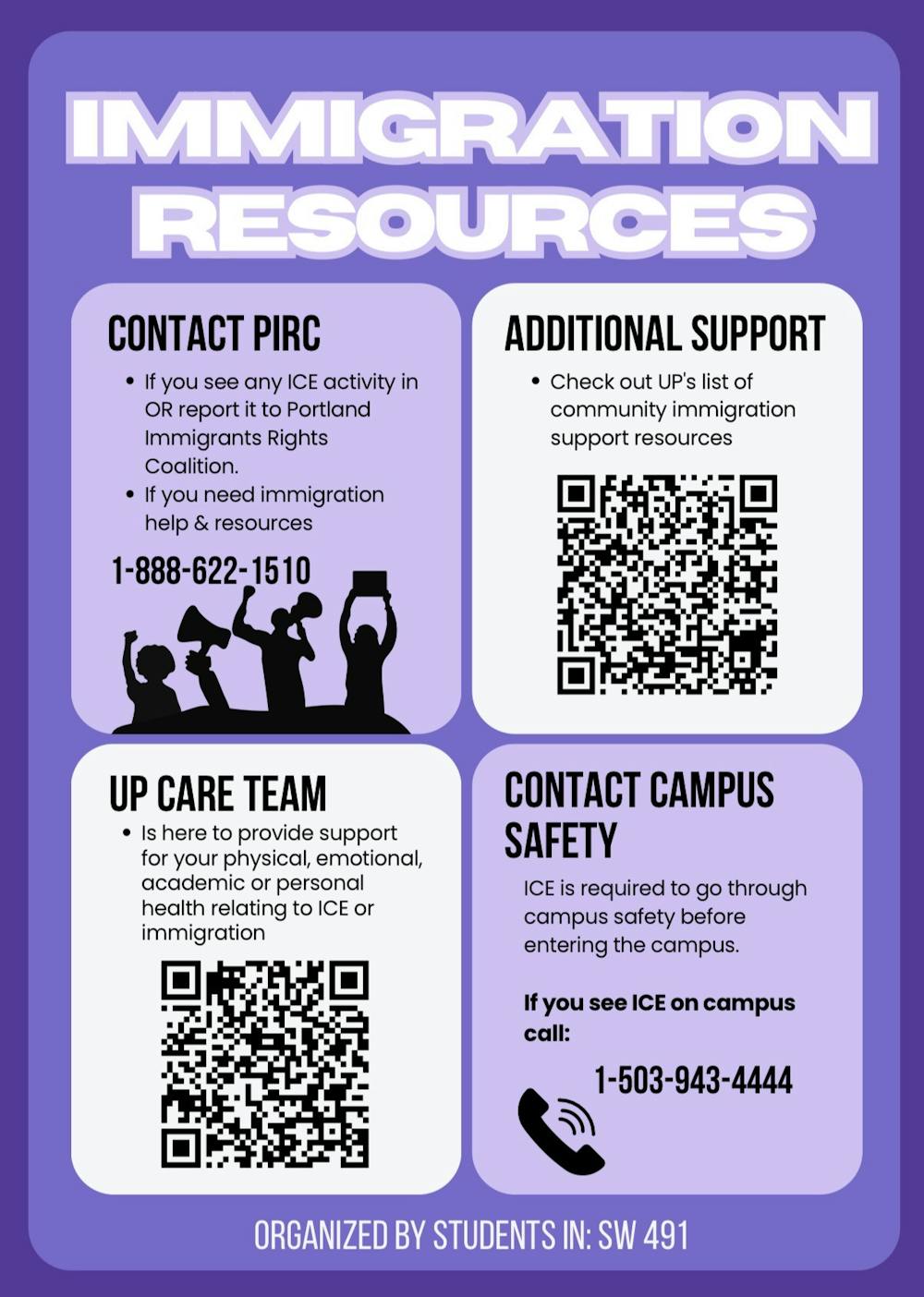
We are becoming increasingly frustrated with the lack of action from UP’s administration. A nearby school district, Portland Public Schools (PPS), has increased security patrols around ICE enforcement, provides clear protocols on their websites, actively collaborates with response teams like Portland Immigrant Rights Coalition and notifies families of their actions to address threats to the schools.
Seeing how PPS has managed to address the reality of ICE presence in North Portland in such critical ways only highlights how little UP has done for its community.
A truly “transformative educational experience” that “centers on service and justice, empowering compassionate change in our community and beyond” while “preparing students and campus to partner with our great City and State to address local and global challenges” ultimately needs to center the community that we are preparing to engage with.
When we can’t even acknowledge the persecution of our migrant neighbors and loved ones happening a few blocks away, how are we supposed to be engaged in partnership with the city and its people?
Using PPS as an example, we are strongly urging the UP administration to implement comprehensive and transparent safety protocols, collaborate with community organizations to provide “Know Your Rights” seminars and modules for students, staff and faculty, and to notify us when ICE is near our campus through emergency communication channels.
Editor’s Note: The university has an official ICE response protocol that has been communicated to students in emails and at least one event by staff members. This protocol is not posted on the official UP website. The university also hosted two ‘Know Your Rights’ trainings in response to ICE activity on Oct. 6, 2025 and Jan. 29, 2026.
Benjamin Barrero is a senior at the University of Portland. He can be reached at barrero26@up.edu.
Ixtzel G. Pina Maldonado is a junior at the University of Portland. She can be reached at pina27@up.edu.
Michelle Fugon Guerro is a junior at the University of Portland. She can be reached at fugongue27@up.edu.
Maria I. Zacarias Martin is a junior at the University of Portland. She can be reached at zacarias27@up.edu.
Maddie Winter is a sophomore at the University of Portland. They can be reached at winter28@up.edu.
Jessica Arevalo Ontiveros is a senior at the University of Portland. She can be reached at arevaloo26@up.edu
Have something to say about this? We’re dedicated to publishing a wide variety of viewpoints, and we’d like to hear from you. Voice your opinion in The Beacon.