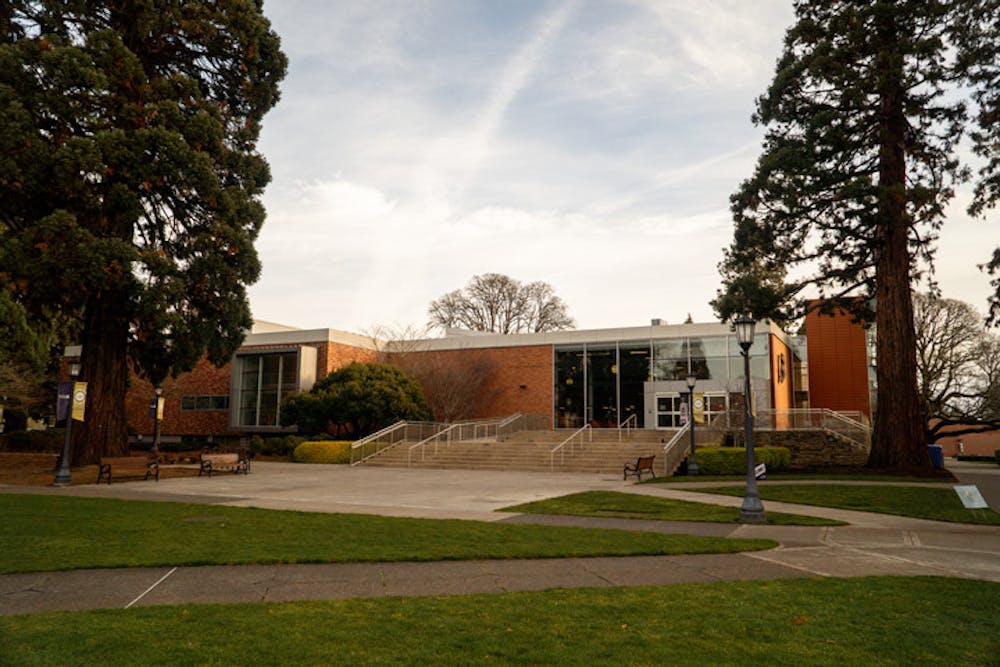
A “March for Solidarity” to show support for community members impacted by U.S. Immigration and Customs Enforcement (ICE) will take place on Feb. 5. The event will begin in front of Clark Library at 4 p.m. before moving along a pre-planned route through campus.
The organizer, first-year nursing major Alex Tuite, says the march aims to support UP’s immigrant community and encourage political action on campus.
“Our community [at UP] is what [people] talk about all the time, about how close-knit we are,” Tuite said. “And yet it feels like people aren't actually supporting [the immigrant] community here. It's not the end result, but [the march] is a huge step in getting the University of Portland more active and aware of what's happening.”
Flyers sharing resources on free legal representation, creating emergency plans, reporting ICE activity and more will be available at the start of the march, according to Tuite.
Participants will then walk on a “highly visible” route through all four campus quads that Tuite and Campus Safety created together.
The event was originally referred to as an “anti-ICE protest” by Tuite, but became a “march for solidarity” instead at the advice of Director of Campus Safety Michael McNerney and Dean of Students Colin Stewart.
UP’s protest policy requires that students notify McNerney and Stewart two business days before a planned demonstration.
McNerney says he was concerned that being “loud and pointed” in critiquing agencies like ICE might put vulnerable community members at risk of being victimized by the agency. He says the march’s new angle keeps Tuite’s intended message while reducing risk.
“The intention is, ‘Hey, UP students, particularly those of you who come from a privileged background where no one is going to look at you and assume that you are an immigrant, we have a voice,’” McNerney said. “‘We should speak up.’ And so we encouraged Alex to keep that centered in the planning process because that's a great message that we fully support, and that doesn't put campus community members at risk.”
Tuite says she first thought of organizing the march while arguing with a high school friend about politics on Instagram. At that moment, she felt like she wasn’t doing enough for the causes she cares about and realized UP, which she had expected to be a politically active campus, felt “silent” to her.
“I feel like the UP campus is kind of a bubble,” Tuite said. “Portland is very active, but UP is more quiet. And that was very surprising for me when I first came here, and I was like, ‘Why don't I just do something, I feel like people would be really into it.’”
Updates on the march can be accessed here.
Maggie Dapp is the Editor-In-Chief of The Beacon. She can be reached at dapp26@up.edu.
Kalena O’Connell contributed to this story. She can be reached at oconnell27@up.edu.