Muslim students find support as well as discomfort at UP

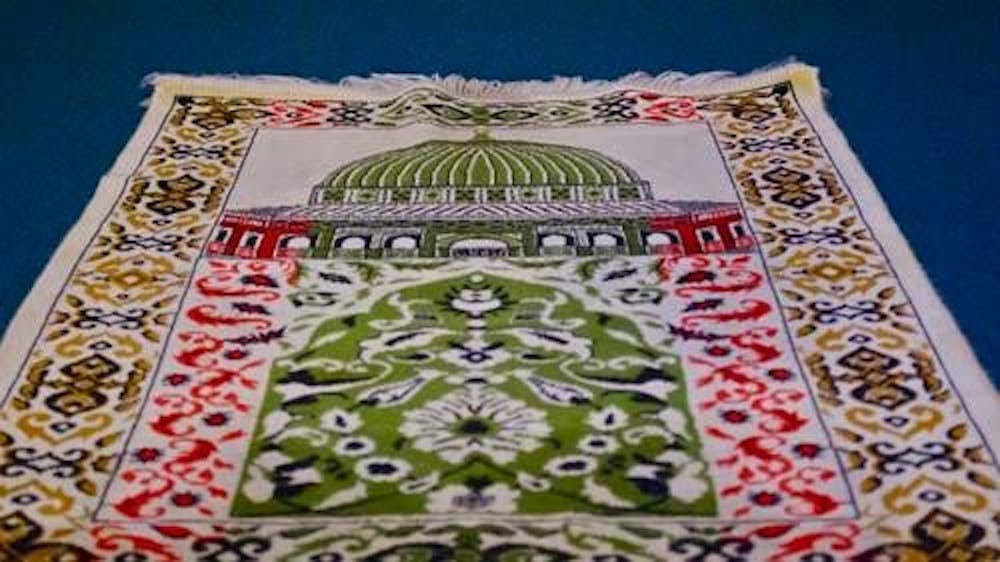
This prayer rug covers the floor of the Muslim Prayer Room in the basement of Christie Hall. The room is designated solely for those students who practice their Muslim faith. People entering the room are asked to remove their shoes as a sign of respect. (Kayla Wong | The Beacon)
By Lydia Laythe, Staff Writer laythe16@up.edu
Although UP is a Catholic university, less than half of UP students identify as Catholic. Amongst the various faiths on campus, a small percentage of students are Muslim.
"All in all, this university has been very accommodating and open," engineering professor Khalid Khan said. "They would provide us big halls when we had 40 or 50 students. Now we have a common prayer room."
Khan estimated that there might be only 20 or 30 Muslim students that he is currently aware of.
Fr. Gary Chamberland, director of Campus Ministry, says it is important to reach out to the students of different faiths.
"We support all people of good will in finding the deepest longing of their lives," Chamberland said. "We know that [longing] to be called God calling them into some sort of relationship [with Him]. We believe that there are many paths to God."
A simple way that the University of Portland shows their support of other faiths is through not only the freedom to practice, but actually creating space in which people can practice their faith. For Muslim students, the University made a special prayer room.
Khan played a major role in the creation of the Muslim prayer room. Khan said the numbers are currently too low to warrant any organized group for Muslim students on campus, but the students don't seem to mind.
Freshman Abdulaziz Alafaliq and junior Nawaf Alanezi said their religion, Islam, is respected by UP's private campus and they are both content with the University's limited involvement.
"We just meet every day in school. We'll see each other in classes," Alanezi said. "We get together but not in an organization."
But physical ability to practice their faith was not the problem they expressed having. Khan said that their prayers could be done in practically any location in the world. Their problems lay in their emotional ability to practice- the ability, or lack thereof, to tell people they are Muslim.
"For me, my faith hasn't changed from [how it was] back home," Alanezi said. "It's all the same. I can do my prayers at home, but here in the States I just don't show it to everyone else."
Alafaliq also says he feels uncomfortable telling UP students that he is Muslim.
"I won't show [my faith] to them because some people just don't feel comfortable about it," Alafaliq said. "I don't want it to affect my studies."
Alanezi further explained the complications of having to hide something as important as faith from even his close friends.
"Last month we had Ramadan. I was fasting but if someone asked me I'd tell them 'no I'm not fasting,'" Alanezi admitted. "Or sometimes when I'm going to do my prayers, I don't tell my friends that I'm going to do my prayers. I just excuse myself and go."
Alanezi feels the most pressure from the students on campus.
"If I told an [adult], or a professor, I wouldn't have any problem," Alanezi said. "But just the kids my age, I don't tell them. I'm sort of afraid of showing it."
Khan believes the media has a lot to do with the way Americans feel about Islam.
"I've lived two-thirds of my life in this country, [and I've found that] the media here is not into objective reporting," Khan said. "They're more into opinion-making."
Alanezi and Alafaliq both feel that the media portrayed Islam improperly.
"Unfortunately, a lot of Americans have not traveled outside of the country," Khan said. "If you go to Europe it's a totally different ball game, because they have been exposed to other cultures. In the United States there's a lot of bias and a lot of misinformation and stereotypes."
The solution to these problems is obvious to Khan and Alanezi.
"The only way is to educate people because prejudice and racism comes from ignorance," Khan said. "You do it one person at a time. Talk to people, or do whatever you can."
The message that Alanezi, Alafaliq and Khan all want to get across is the inherent similarities between Christianity and Islam.
"I think there is a lot of commonality, because when it comes to human values we are the same," Khan said. "[We believe in] living in peace with other people. Love of neighbor, love of God."
Despite education, Alanezi believes that the stereotypes and prejudices remain ingrained in the minds of his peers.
"They don't believe it. They believe what they hear," Alanezi said. "They don't believe what they learn. I just don't get it."
On the other hand, Alanezi expressed admiration for students who openly expressed their faith.
"I like when I see them practicing their faith. I like when I see my friends go to church," Alanezi said. "I don't see many students go to the church, but I like the students that go to the church, just regular students that practice their faith. I respect them."
Mutual respect for different faiths is something that Alanezi expressed indirectly, and something that is necessary in order for there to be any progressive change regarding the stereotypes and stigma attached to the Islamic faith
"Don't judge people by their faith," Alafaliq said.
"Don't judge people, because you don't know what's inside," Khan added.
Muslim Prayer Room
Location: Basement of Christie Hall
The prayer room may be accessed through the International Student Services Office from 8:30 a.m. to 4:30 p.m.
It is open to all members of the University Community.

Professor Khalid Khan says Muslim prayer and worship can be done anywhere. However, the difficulty for UP students lies in the inability to tell other people they are Muslim. (The Beacon)

Professor Khalid Khan, junior Nawaf Alanezi and freshman Abdulaziz Alafaliq represent and practice their Muslim culture at UP. (Giovanna Solano | The Beacon)