Have you ever sat and listened to an English professor lecture about the symbolism of colors or dialogue and wondered, “Did they even enjoy this book?” When the lectures are over and essays are graded, what do they pick up off the nightstand and dog-ear?
Whether it’s Shakespeare or William Butler Yeats, English professors know their way around classic literature. Having a way with words and texts proves valuable in their profession. But what about reading for personal enjoyment?
The Beacon sat down with a few of UP’s English faculty to discover their guilty pleasure reads.
This group of scholars gravitates toward literature that reflects their youth and the choices we’re often tempted to make, but don’t. From stories of rock bands to meditations on lives not lived, these books offer professors a way to experience, revisit and reimagine those moments through fiction.
However, the message from these professors overwhelmingly followed one line of reasoning: There is no such thing as a piece of literature you should feel guilty for enjoying. If you're reading, you're doing something right.
“Our Band Could Be Your Life” by Michael Azerrad
Professor John McDonald, one of UP’s published authors, knows a thing or two about a good read.
McDonald says he loves books that encapsulate what some would consider a crossover of literature and the arts — rock bands in their prime. Rock memoirs take McDonald back to his youth and the times he was involved in the punk indie music scene.
“I’m really into music and oral histories from the 80s and 90s,” McDonald said. “I love reading about stuff that I was a part of.”
He singles out Michael Azerrad’s “Our Band Could Be Your Life.” The book follows stories of heavily influential underground bands from the 1980s. The pleasures and pitfalls of rockstar lifestyles are displayed as bands like The Replacements and Black Flag tour the U.S. and rise to fame.
“It’s just all these bands that didn’t have any label support, and they just got in vans and drove all over the U.S. and Canada,” McDonald said. “[They were] playing shows for sometimes five people, sometimes 200 people.”
McDonald said he doesn’t believe in the concept of a guilty pleasure read.
“I don’t believe in guilty pleasure anything,” McDonald said. “I think whatever you’re interested in, you don’t have to feel guilty about.”
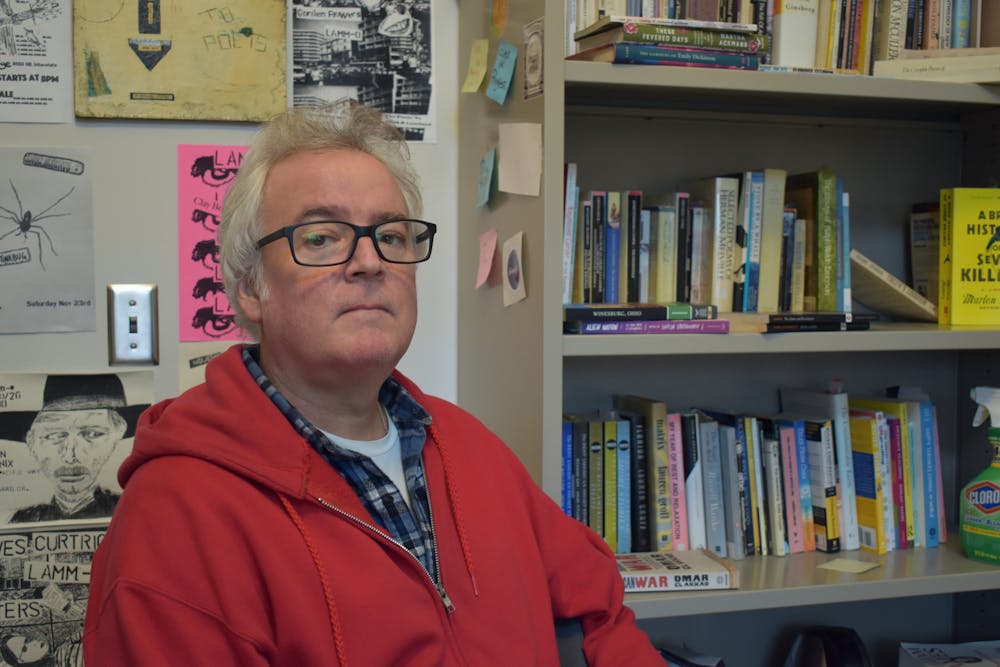
Professor John McDonald poses for a photo in his office.
Media Credit: Sarah Knight-Weiss / The Beacon
“All Fours” by Miranda July
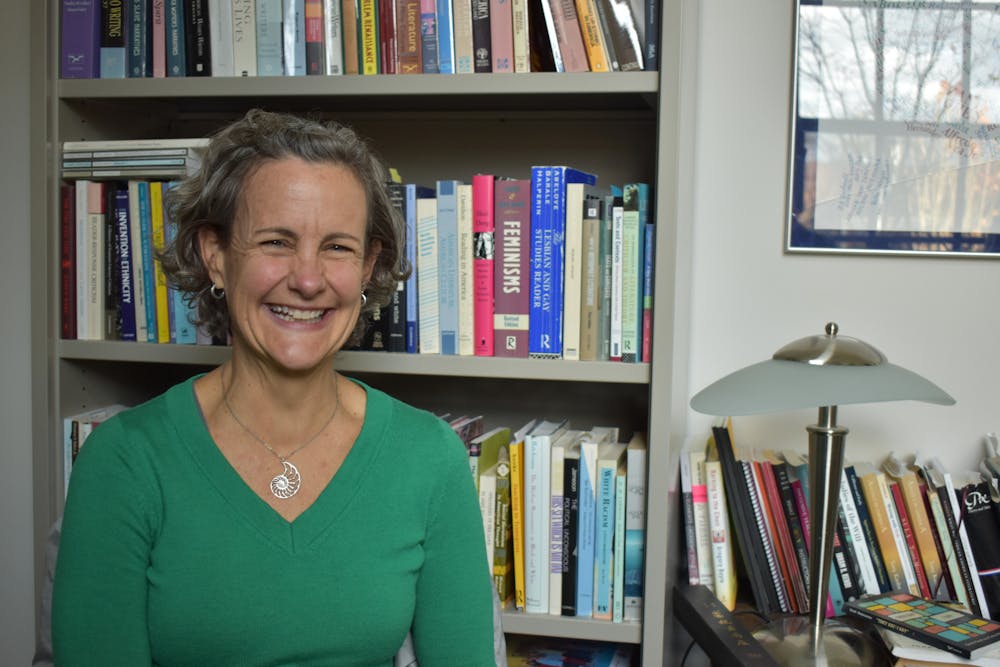
Professor Molly Hiro can be found with her nose in a book when she isn’t teaching, cooking or running.
While Hiro specializes in teaching American, African American and multi-ethnic American literature, her guilty pleasure picks stray from those categories. Hiro says she likes stories that allow her to live vicariously through characters that make crazy life decisions.
“I like to call them ‘women-on-the-edge’ books,” Hiro said. “Where a person like me, with my profile, goes and does something crazy.”
Hiro mentioned “All Fours” by Miranda July, in which a middle-aged woman leaves her husband and child to live in a motel. The protagonist begins a nefarious relationship while reinventing herself and her life.
Hiro also spoke about morality within content consumption and how humans are influenced by societal perceptions of reading from a young age. One might consider some forms of media intake “bad,” like watching movies or TV shows, while reading is considered “good.” This perception can cause guilt when we feel like we have or haven’t been investing in “good” forms of media, according to Hiro.
Hiro agrees with McDonald that one need not feel guilty about reading, hoping to break down the idea that certain forms of media are more intellectually beneficial while lowbrow media is potentially harmful.
The New York Times
Professor Lars Larson takes a different approach to guilty pleasure reading. Larson says his guilty pleasure reading is keeping up to date via The New York Times.
“As a literature professor with an anti-elitist agenda, I feel zero guilt with regard to reading any book, regardless of its genre,” Larson said. “But my guilty pleasure read — something I consult at least three times daily — is The New York Times in all its abundance.”
Larson quotes Ralph Waldo Emerson to explain his answer: "Read not the times, read the eternals.”
Despite Emerson’s words against solely tuning into daily news instead of classic literature, Larson finds pleasure in keeping up to date with current events.
“There's always something every minute,” Larson said. “A fresh insult, a new war, a luminary's obituary, a fresh turn of phrase. I use this check-in as a reward, an indulgence, a time-suck. It's the closest thing I have to feeling guilty while reading.”
According to these three literature professors, there is no such thing as guilty pleasure reading. There should be no guilt behind enjoying a specific genre or medium — whether that means diving into a book about your favorite bands, a series of interesting decisions or simply your favorite news source.
Emily Friesen is a news reporter for The Beacon. She can be reached at friesen28@up.edu.